When excuses become a sector problem
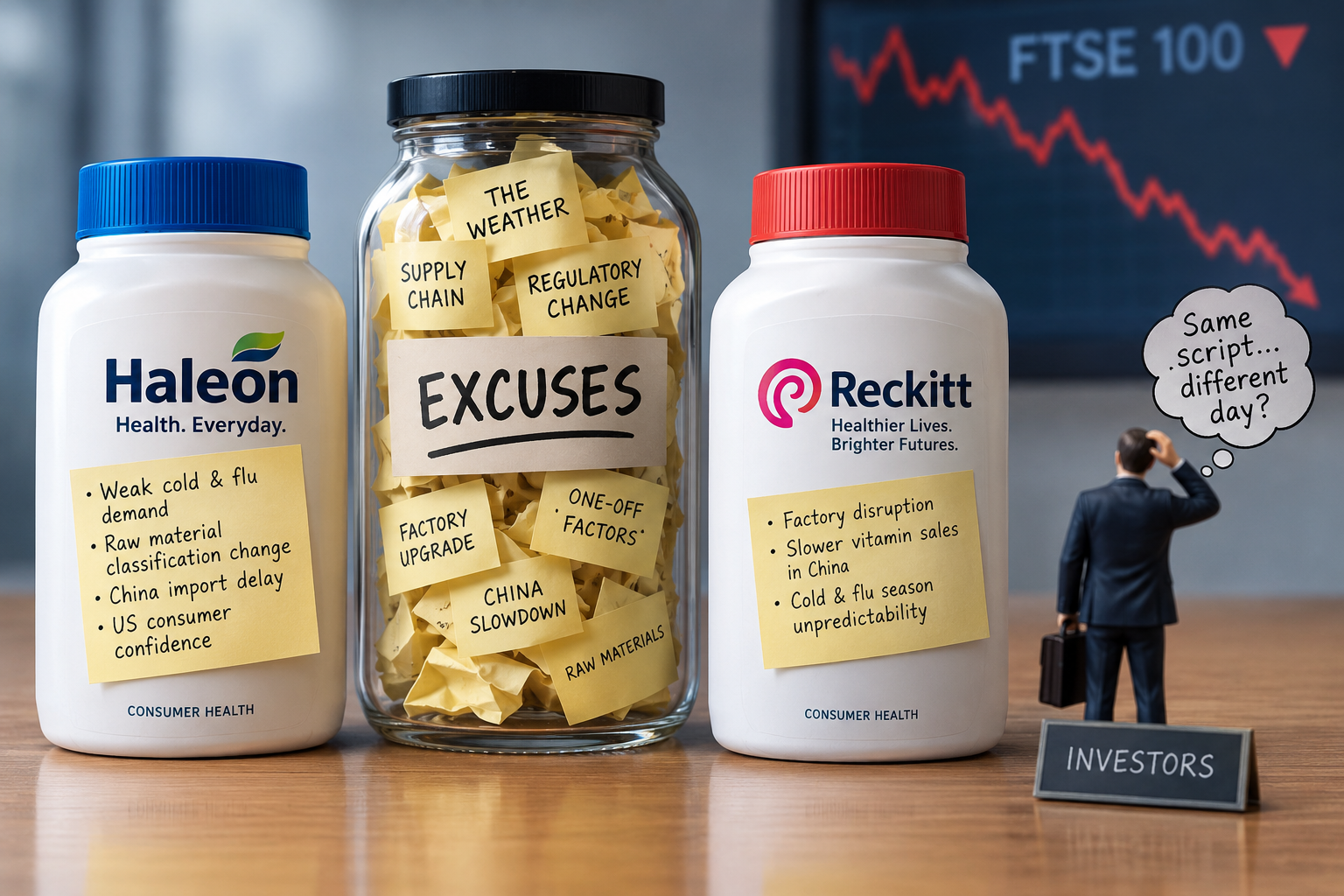
Two FTSE 100 consumer-health giants cut their growth forecasts within 48 hours. Their explanations may be different, but investors are asking the same question: when does bad luck become a management problem?
A quick note before we start. This is a new format for The Signal & The Story, a regular read on the story behind the market’s biggest moves, through a communications lens. If you find it interesting, the best thing you can do for us is forward it to a colleague or friend who might get something from it too.
All comments are genuinely welcome: hit reply, tell me what I’ve missed, or what I have got wrong... This is meant to start conversations, not end them.
Right. Haleon shares are down a lot at the time of writing. I keep having to change by how much, as it is swinging around all over the place… But right now, they are down 15%.
In 2022, GSK spun the biz out as a consumer-health “value unlock”: a defensive, pricing-power, buy-it-in-any-economy portfolio of Panadol, Sensodyne and Centrum. It floated at 330p. Four years on, today’s drop has taken the shares in and around that price.
How did this happen? Haleon cut its full-year organic revenue growth guidance to around 2.5%, down from the 3–5% range it had been defending, after third-quarter growth of just 2.6%. The blame fell on weak cough, cold and flu demand in North America, its biggest market, and a raw-material classification change that forced it to halt imports of certain Centrum products into China “until further notice”.
CEO Brian McNamara said the company was “clear on where we need to improve”.
The interesting part is 48 hours earlier, FTSE 100 rival Reckitt delivered a strikingly similar message. On Tuesday it cut its own core sales-growth guidance to 3.5–4.5% from 4–5%, citing a factory upgrade that had disrupted Lysol supply in the US, slower vitamin sales in China, and a cold and flu season proving difficult to predict. The shares fell around 4–5%, having already endured a difficult year.
Two of the biggest consumer-health companies in the index, in the same trading week, delivered almost the same message: lower growth, a tidy list of operational and market-specific explanations, and reassurance about the underlying business.
Those explanations may be entirely valid. But arriving together, in the same week, they raise tough questions.
RBC’s analysts put the discomfort succinctly. Trying to make sense of Reckitt, they admitted they could not tell whether the company was “serially unlucky”, suffering from “insufficient prudence and communication in its setting of expectations”, or “paying the price for many years of underinvestment” - “maybe there’s a bit of all three”. That is the uncomfortable part. Investors can forgive a soft quarter. What they struggle to price is a business where it has become genuinely hard to tell a temporary setback from a recurring execution problem.
Then there is the buyback. On the same morning, Haleon announced a further £500m of share buybacks. There is nothing wrong with returning surplus capital in principle; a cash-generative business with few better uses for the money is right to hand some back. But the timing here may be a message of its own. Announced alongside a downgrade, a buyback can read less like confidence and more like a change of subject. It does not answer the question the market wants to know, how growth gets fixed. Haleon’s share price gave the verdict: it is difficult to repurchase your way out of an existential question.
The Comms Read
The most revealing commentary this week came from RBC’s analysts. RBC’s assessment of Reckitt was striking precisely because it left every explanation on the table at once. When your house brokers possess this view, the problem is no longer the latest miss. It is whether the guidance is dependable full stop. Jefferies was even more blunt, querying Reckitt’s reliance on “new one-off factors”, as a succession of one-offs is arguably just a trend in disguise.
That is the communications lesson: explanations lose their power when they keep changing but keep arriving.
Would an explanation still convince if a competitor used an almost identical one? If yes, you need to be more specific – add in details like the scale, duration and cure. Investors anticipate a certain level of uncertainty (regulatory, weather, macro etc.), but they do expect you to know your exposure, name it, and stop being surprised in public by risks that were hiding in plain sight.
The overarching lesson is that confidence is built through consistent delivery, realistic expectations and clear communication.
The perfect example of this in the London market is Lord Wolfson at Next, who has delivered a total shareholder return of around 2,900% since taking over in 2001.
GLA & DYOR.
Disclaimer
This newsletter is published by James Lea / CorpCast for general information, educational and journalistic purposes only. Nothing in it constitutes financial, investment, legal or tax advice, or a personal recommendation, and it is not an offer, invitation or inducement to buy, sell or hold any security, cryptocurrency or other financial instrument.
Any views, opinions, forecasts or interpretations expressed are the author’s own personal opinions at the time of publication, do not reflect the views of any business or entity the author is affiliated with, and may change without notice. No account is taken of any reader’s personal circumstances, objectives or financial situation, and nothing here should be relied upon as the basis for any investment decision.
The author may from time to time hold long or short positions in securities, cryptocurrencies or other assets referenced in this newsletter, and may transact in them at any time without further notice. This is a standing disclosure covering all issues and is not repeated or itemised per asset.
Investing and trading involve substantial risk of loss, including the potential loss of your entire investment. Past performance is not a reliable indicator of future results. Figures, data and third-party information are believed reliable but are not guaranteed to be accurate, complete or up to date.
James Lea / CorpCast is not authorised or regulated by the Financial Conduct Authority. Always conduct your own independent research and consult a suitably qualified, FCA-regulated financial adviser before making any investment decision.

Ready to Transform Your Investor Communications?
Turn every update, report, or conversation into high-performing content that drives measurable business growth and investor engagement.